|
| Viktor believes in actions speak louder than words. |
Viktor
limped into the half-grassy yard of House No. 16. His fur was black with
streaks of white. He had sad eyes coupled with an air of tired acceptance. His
left leg was bent at an awkward angle. It was obviously broken some time back,
and since it wasn’t tended to, it became deformed. If he was in pain, he didn’t
show it. He moved around quite swiftly despite his handicap. He didn’t make any
pleas for food. Or attention. For a couple of days, Viktor kept the humans of
House No. 16 under observation. He tentatively accepted their offering of peace
- a mackerel – and proceeded to stay put. The other felines around the place
gave him a wide berth. SAM (Socially Awkward Meow) anyway would dart
 |
| Sam: I have one responsibility - look cute. |
in and out
of the house after having her food. She was least interested in anything else
as long as she got her daily grub and rub from the humans. Plus she was a cat
with no pretensions of having a heart for a fight. Simple Dimple was yet to be
informed by her sister, Shashikala the Charming Schemer, about the course of
action required for this new presence. Shashikala believed in exercising her
territorial rights at every cat-given opportunity. But she was missing in
action. She had gone to judge the Desert Springs Annual Caterwauling Contest
(We’re the Wailers). So, Dimple didn’t take much notice of the newcomer and was
just happy to lie around doing what she does best – swat flies. She had once
confided over a bowl of Whiskas that swatting imaginary flies makes her feel
complete.
 |
| Simple Dimple gets her good intentions mixed up with no intentions. |
The first
thing Shashikala did after her return was to swat Dimple on her nose while she
was dreamily swatting away. By doing so, she broke one of the main codes that
cats live by – Thou shalt not awake
sleeping feline rudely. Shashikala then proceeded to add insult to injury
by rebuking her loudly for not taking any initiative to address the issue at
hand – Viktor’s presence.
Dimple, nettled by the swat and the harsh meows, went
to have a word with Viktor. Not a dent was
 |
| Shashikala holds her cards close. |
made. Viktor stayed put, grooming
himself while watching Dimple warily. Dimple, still very upset, decided to get
physical. Fur flew. But when the dust settled, it was quite evident that it was
only Dimple’s fur that flew. Both Shashikala and Dimple were shell-shocked by
this display of raw aggression by Viktor.
This lame
brooder was the real deal. It reminded Shashikala of one of her ex-lovers –
Charlie Cinchpokli. Holy Meow! That one could fight a dozen alley cats without
breaking a sweat. A warm feeling came over her. Thinking of Charlie always made
her a bit woozy. Shashikala, alumnus
extraordinaire of the prestigious House of
Fangs, knew Viktor was a cat from the streets and wouldn’t fall for her
finishing school charms. A fragile peace was brokered. All of them kept to
their own corners and despite a few snarls here and there, no major skirmishes
were reported. But Shashikala kept on needling Dimple about her inability to
overcome a lame cat. ‘
Top cat, you aren’t.’
She’d hiss every time she passed Dimple.
That summer,
two events occurred that changed the status quo. One fine humid day, Charlie
 |
| Charlie Cinchpokli - Mercenary for hire. Being mean is his business. |
Cinchpokli, stretched his way into House No. 16 and came face-to-face with his
former lover. Shashikala was very surprised and was all ready to welcome him
back into her life. With Charlie by her side, she had nothing to fear. But hang
on. Charlie still hasn’t got over the fact that Shashikala dumped him at a
garbage dump. So, he kept his distance despite the warm welcome. He had learnt
the hard way that a cat can administer healing licks on all wounds, but not the
ones inflicted on tender hearts. He was surprised by Shashikala’s presence
though. If he had the option, he’d prefer to live far away in the next
neighborhood, but he had always been a hired gun. His line of work meant he
couldn’t be fussy about the places he inhabits. Even if that place houses the
love of his life. The promise of regular meals is something that cannot be
ignored. Especially during these recessionary times. During one of his
nocturnal walks, he had bumped into a feline who told him that there’s a
constant supply of food at a particular location. He could be a part of the
gang provided he took care of one nasty piece of business – a lame cat named Viktor.
Charlie purred happily. This seemed like one of those win-win situations. All
he knew was to fight. And how. He lost count of the times he had emerged
victorious. And this was a lame one. The deal was formalized with a paw shake
over a half-eaten piece of Norwegian Salmon. Stolen, of course. A full moon
cast its glow on this not-so-holy alliance. If this were happening deep inside
an African savannah, you’d have heard a pack of hyenas laughing. Charlie
thanked the feline for this offer and then remembering his manners somewhat,
asked her how he should address her. ‘Dimple’
the cat smiled, ‘just call me Dimple’.
Dimple walked back home dreaming of the day when Charlie would take care of Viktor
and she’d get back to swatting flies in peace. And yes, shut up Shashikala too.
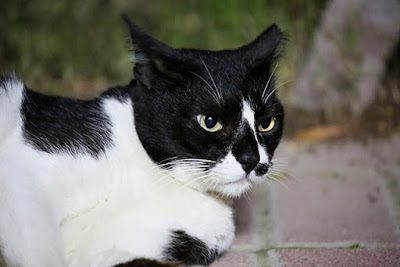 |
| Charlie can't believe his luck on landing such a sweet deal. |
The second
event of that fine humid day was that Viktor disappeared. No, Charlie had
nothing to do with it. He didn’t even see Viktor. Dimple felt more than a bit
perplexed at the turn of events. She confided in Shashikala that she was the
one responsible for hiring Charlie but now she’s not too sure whether the
contract is binding. Shashikala felt a headache start from her tail as she
heard Dimple out. Trust Dimple’s simple mind to land themselves in further
trouble. You see, once a cat is hired for a purpose, and if that purpose
disappears, the contract still stands. Charlie showed up. It’s not his fault
that Viktor vanished. And now he’s entitled to his fees – the daily meals
promised. Shashikala would have liked the situation if Charlie had forgiven
her. But it was quite evident that he hadn’t.
So, once
again, things fell into a pattern. Charlie’s pattern, that is. He was very
pleased with the way
 |
| One of Charlie's many fans who dig his bad cat persona. |
things have progressed. It was a nice neighborhood. Lots
of trees. Lots of juicy-looking birds too. He was the biggest cat around. He
could bully anybody he wanted without even the slightest retaliation. A couple
of felines have been checking him out. Truth be told, he was also giving them
the glad eye. His coat was shiny black with a white patch on his chest. Plus he
had his bad cat reputation. A combo that drove the chicas wild. Boy, was he
glad to call the shots. First, he took control of the food supplies. He made
sure he ate first before the others could. He would follow the human as food
was distributed and snarl at the others to maintain a safe distance. He also
fancied himself as the human’s bodyguard of sorts. Not like a dog. That would
be beneath him, of course. But a guard with a Samurai kind of mystique. Yes, he
liked that image. Samurai Charlie. He liked it a lot.
To top it
all, he could ignore Shashikala’s friendly overtures. He made a stabbing motion
to his heart and grinned. Life was just perfect.
Life’s
funny. Just when you think it’s perfect, it bowls a googly. Viktor going
missing wasn’t just a sadistic Game of Thrones plot twist – you love a
particular character, identify with it, adore it and before you know it, heads
go rolling into the deep abyss of heartbreak and disappointment. A similar
thing happened to Charlie Cinchpokli. The humans had served tuna chunks for
lunch. The breeze was just the right side of cool. He could feel his entire
body relax in anticipation of a postprandial snooze. Now only if he could get a
human to stroke his chin. The mere thought made him lie on his back with his
legs in the air. Beauty sleep, here I succumb to thee.
 |
| The return of Viktor stirs things up. |
At that
precise moment, Viktor limped back inside House No. 16. Shashikala spat a
hairball when she spotted him. Dimple uttered an oath and went scampering to
Charlie’s side and committed the same crime that cats should never do – Thou shalt never wake sleeping felines
rudely. Charlie opened one eye and surveyed the scene. He was ready to bite
off Dimple’s head for her misdemeanor. But he was a professional. And what he
saw before him was something his left paw can handle. A lame
cat. He snorted. Somebody’s in for a
hiding.
Both
Shashikala and Dimple realized there was something different about Viktor. His
misshapen left foreleg didn’t exist any longer. There was instead a stump. Suddenly, there
was no mystery behind Viktor’s disappearance. A human had taken him to a place
where they make animals feel better. There a man wearing green overalls removed
his damaged limb. He was taken care of. When he recovered completely, Viktor
was dropped off at the same place where he was picked up – outside House No.
16.
Viktor
realized things have changed. There’s an alpha male in charge of things now.
And he’s spoiling for a fight. Viktor sighed. He avoided fighting as much as he
could. No good comes out of it. But the world thinks very differently. He liked
House No. 16. It’s peaceful as long as everybody behaved. The humans were kind
too.
Charlie
padded about circling him, sizing him. Shashikala and Dimple were watching a
bit warily from
 |
| Simple Dimple finds a vantage position to watch the fight. |
the sidelines. Sam was also nearby ruminating about why cats can’t co-exist in peace. It’s another thing
that she prefers her own company. But she didn’t mind this distraction. There’s
a part of her that enjoyed fights. Well, as long as she’s not playing a part in
it.
Charlie
couldn’t make up his mind. Should he just end it in seconds or make a show of
it. A quick KO might be attributed to luck. Whereas a painfully orchestrated
beating would show everybody who was the boss. He grinned like a Cheshire cat.
He would go for the latter. Give everybody a show. Hey, he’s the big bad boss.
Charlie
decided to start with a few stinging slaps. But first a good eye-to-eye
showdown accompanied by lots of guttural snarls. That softens them up. Charlie
danced up to where Viktor was
 |
| One-Punch Viktor - A cat that has seen life is no ordinary cat. |
crouching. An instant later he realized he was
flying. It would have been a nice situation if he were flying behind one of
those pesky swallows. But it wasn’t a nice situation. It was, in fact, a
horrible situation. All Charlie could remember (in extreme slow motion) was how
Viktor
stood up on his hind legs, gracefully pivoted like a Tai Chi artist, and landed
a mighty right straight on his chin. A right that sent him flying over the
startled eyes of Shashikala and Dimple. Charlie crashed on a pile of broken
branches, surrounded by scraps of his tattered reputation.
And that’s how the legend of ‘One Punch’ Viktor was born.